
Skip to content
🍪

Cookie information

This site uses cookies to provide you with an optimal experience. Legal notices and GDPR

🍪 Cookie preferences

Choose to accept or decline certain cookies. Our cookie policy can help you make this choice.

Cookie information

Essential cookies are necessary for the proper functioning of this website.

Statistics

We use Google Analytics to anonymously collect statistics on site visits and interactions.

Embedded content

We use external services (YouTube, OpenStreetMap, etc.) to display videos, maps, or other useful content. These services use their own cookies. Declining these will automatically block the display of this content on the site.

Cimetière Saint-Roch

Discovery and recreation

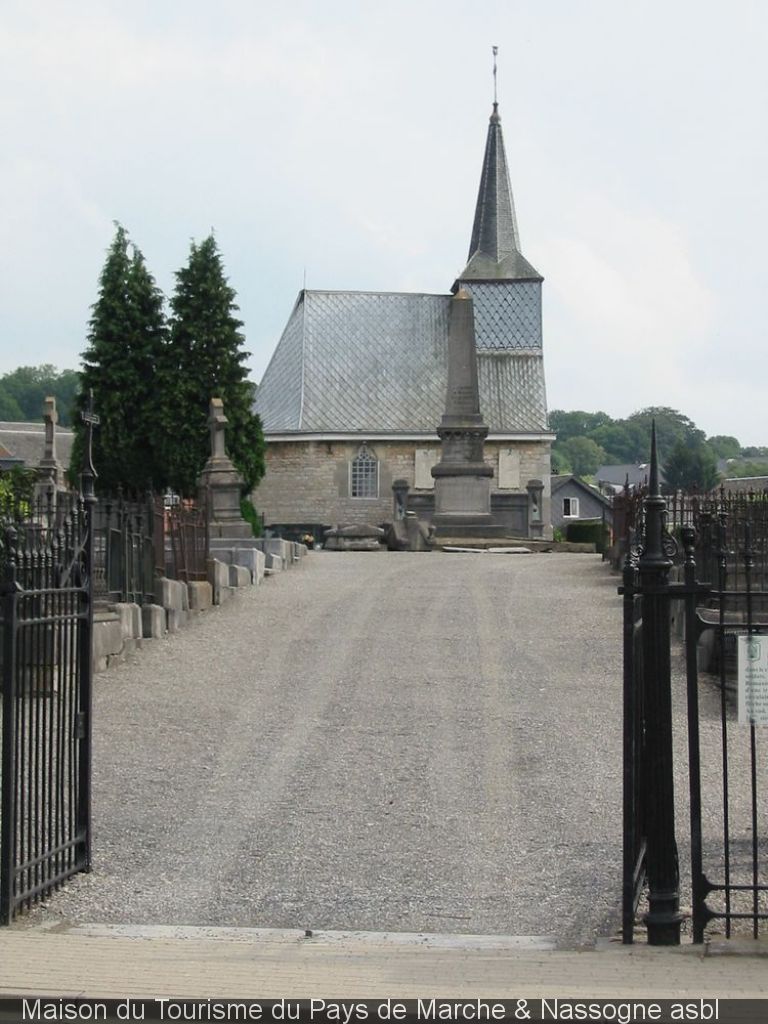
Saint-Roch Cemetery is characterized by very old graves, and an extension of the cemetery ('new cemetery') was built across the road. 'The old cemetery' is distinguished by its numerous graves surrounded by wrought iron fences. Three distinct locations are occupied by children's graves adorned with porcelain cherubs. Before the end of the 18th century, this extra-muros cemetery was reserved for plague victims, non-Catholics, and foreign soldiers who died in Marche. In 1784, Joseph II's decree prohibiting burials in churches and within city limits for hygiene reasons forced the people of Marche to relocate the cemetery that was around Saint-Remacle Church. The new 'out-of-the-walls' cemetery is located 'outside the Porte Basse, near the waters of Marche' and is called Saint-Pierre Cemetery. However, the site was poorly chosen (the burial grounds were flooded), and burials only took place there until 1789. It was on December 22, 1787, that Saint-Roch Cemetery became a parish cemetery. The cemetery's location is not far from the place known as 'Maladrerie' (an establishment formerly dedicated to those suffering from leprosy, now referred to as a leper colony). By the end of the 15th century, this maladrerie, whose existence is documented very early on, became a hospital. Leprosy was a common disease at the time, and before the 17th century, anyone suspected of being infected had to go to Liège for examination. If the diagnosis was confirmed, the isolation of the patient was ordered, and the community provided for the leper's needs. They were given a hovel near a watercourse (in Marche, at the site known as 'Fontaine des Malades' in Lorichamps, near Bourdon), furniture, utensils, and a thick gray garment characteristic of lepers, who announced their presence with 'cliquettes' (rattles) and whose encounters were greatly feared. Not far from the chapel and the cemetery lies this 'Fontaine des Malades' or 'Source des Malades'. According to popular belief, plague victims, epileptics, and those with neuroses were often cured by drinking the crystal-clear and miraculous water from the spring.
Address chaussée de l'Ourthe 6900 Marche-en-Famenne

Equipment & services

Parking

Share the article

Currently on Marche