
Skip to content
🍪

Cookie information

This site uses cookies to provide you with an optimal experience. Legal notices and GDPR

🍪 Cookie preferences

Choose to accept or decline certain cookies. Our cookie policy can help you make this choice.

Cookie information

Essential cookies are necessary for the proper functioning of this website.

Statistics

We use Google Analytics to anonymously collect statistics on site visits and interactions.

Embedded content

We use external services (YouTube, OpenStreetMap, etc.) to display videos, maps, or other useful content. These services use their own cookies. Declining these will automatically block the display of this content on the site.

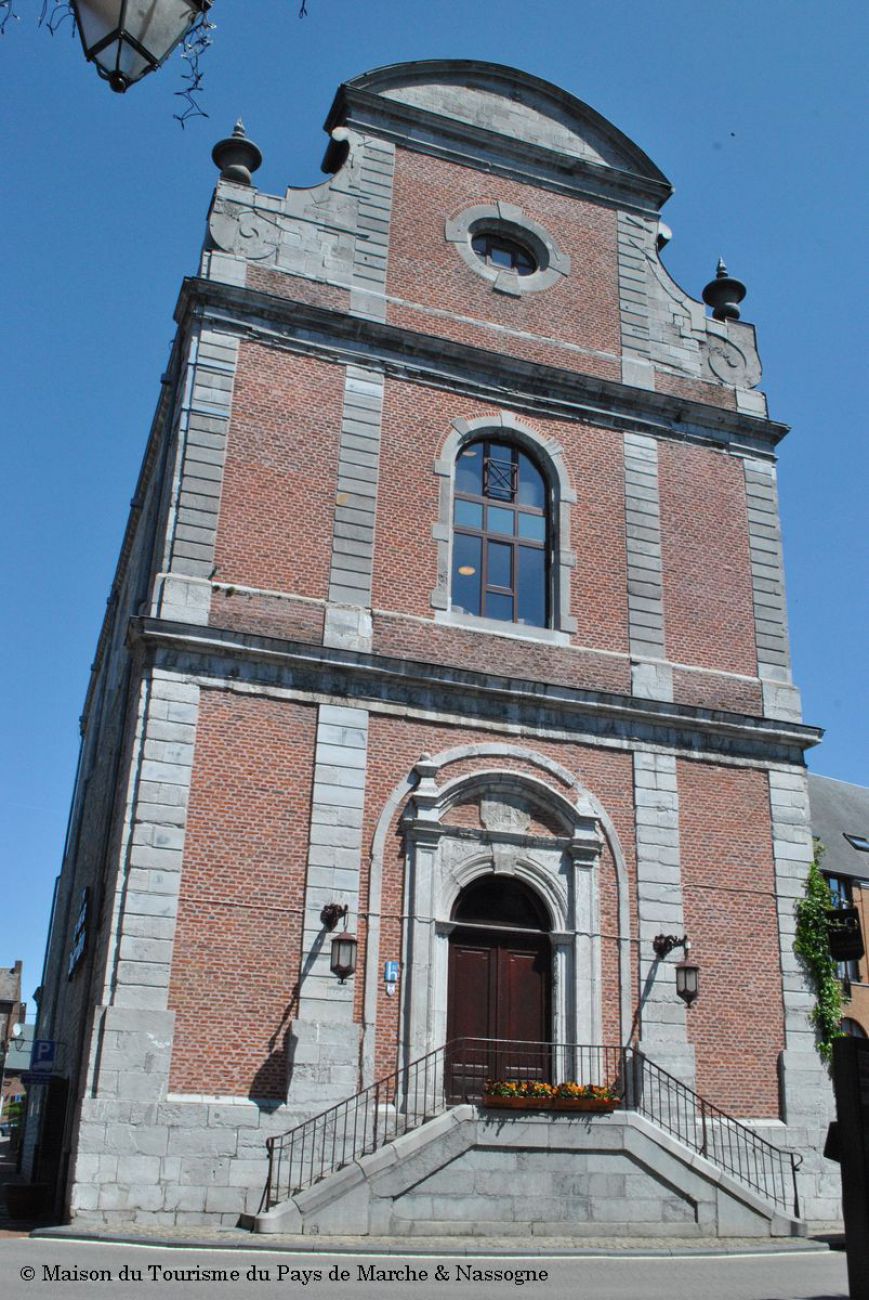
Ancienne église jésuite / Quartier Latin

Discovery and recreation

This former Jesuit church, classified in 1985, is the only remnant of the old Jesuit college from the 18th century. Today, it houses a charming hotel complex. Authorized to teach in 1572, some Jesuits from Huy came to teach in Marche-en-Famenne starting from 1620 or 1627 (according to different sources). After an initial establishment, they built a college on the site of Rue des Brasseurs. An ideal Jesuit college consisted of three parts: the 'House' of the Fathers (a separate building around a cloister), the classrooms (grouped around a courtyard), and the service areas, which served the 'House' and opened onto the street. The 'House', built between 1650 and 1671, was located in the wing adjacent to but preceding the church. The Fathers' garden was situated at the back of the wing, towards the ramparts. From there, an underground passage connected the Jesuit college to an orchard outside the city walls. Regarding the church, it is possible that an initial building with a simple rectangular nave and ceiling existed in the 17th century. The college church, whose façade is visible today, was constructed between 1732 and 1740. The façade, made of brick and blue stone, is structured in compartments: vertically through pilasters and horizontally by entablatures. A curved pediment crowns the façade and is framed by volutes. All these features mark the influence of the Baroque style (17th-18th centuries). A staircase dividing into two flights precedes the entrance. The monogram I.H.S. (transliteration of the name Jesus and emblem of the Society of Jesus) surmounts the entrance portal. The interior of the church was vaulted with ribbed arches, showcasing Gothic style, while decorations of palmettes heralded Neoclassicism. An entrance gallery ran along the church on the south side and opened onto the classroom courtyard. The Jesuit college was suppressed on September 20, 1773, by Pope Clement XIV under the influence of Austrian politics. On November 1, 1773, a provisional college was established, and teaching was provided by designated secular priests. One of the first state schools, although still run by priests, was the Ordinary College of Marche, created in 1777 (the Government of Maria Theresa of Austria converted it into a 'Theresian college'). Decommissioned, the church was returned to worship for a few years after the great fire of 1806. The spandrels located on the church portal testify to its new use as a communal hall (or Casino) in 1871. In 1875, the façade was completely rebuilt, and the 'House' of the Jesuits was transformed into a communal school for boys. Around the same time, a prison was built on the site of the classroom buildings. Subsequently, the communal school was converted into a barracks for the city firefighters, while the prison was partially demolished to construct a wing for the firefighters' garage and an office for the R.T.T. In 1989, all the buildings were demolished, except for the church, which has been classified since 1985. Emergency excavations were carried out by the Historical Circle of Marche-en-Famenne in July 1991. Then, two wings were built, closing the complex in a U-shape. This ensemble now houses the Quartier Latin hotel complex. This name is historically justified: indeed, present for 150 years (1650-1794), the Humanities College was also called the 'Latin school'. According to the rules, students were required to speak Latin, both with the professors and among themselves.
Address Rue des Brasseurs 2 6900 Marche-en-Famenne

Equipment & services

Parking

Share the article

Currently on Marche