
Skip to content
🍪

Cookie information

This site uses cookies to provide you with an optimal experience. Legal notices and GDPR

🍪 Cookie preferences

Choose to accept or decline certain cookies. Our cookie policy can help you make this choice.

Cookie information

Essential cookies are necessary for the proper functioning of this website.

Statistics

We use Google Analytics to anonymously collect statistics on site visits and interactions.

Embedded content

We use external services (YouTube, OpenStreetMap, etc.) to display videos, maps, or other useful content. These services use their own cookies. Declining these will automatically block the display of this content on the site.

Eglise Saint-Isidore ou Saint-Georges

Discovery and recreation

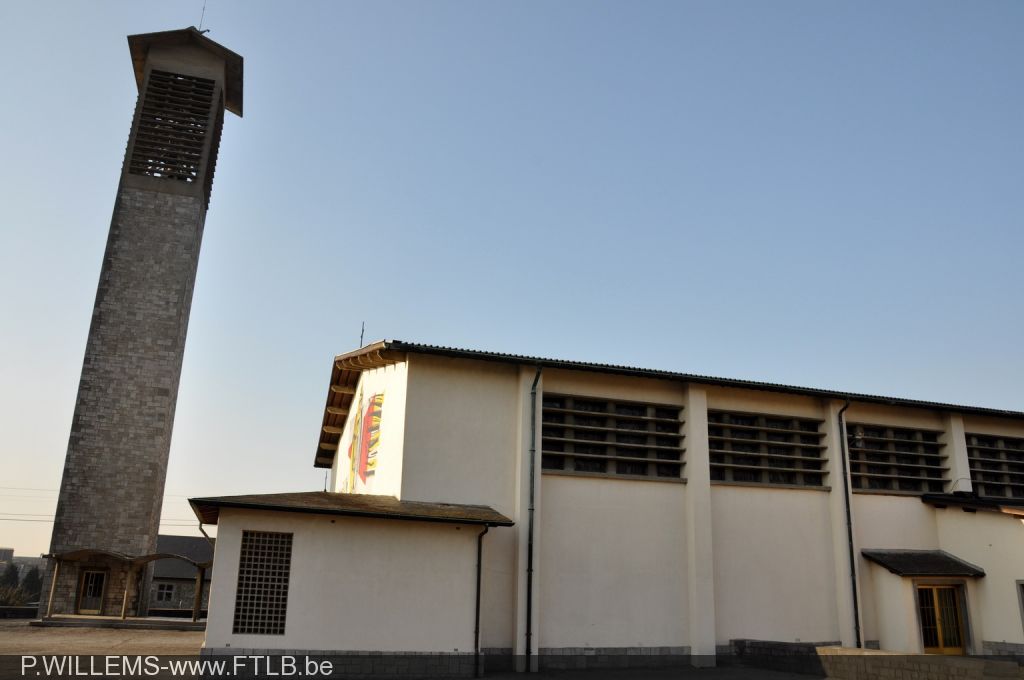
The church was rebuilt in 1954, following the bombings of World War II, based on plans drawn up by architect Victor Sarlet. The independent bell tower, covered in limestone, dominates the building and the village. Characteristic of its era with concrete sound hoods and a stylized rooster, it is disproportionately large compared to the church. The church, constructed of concrete, is covered with a white coating, except for the apse which is made of limestone. The bell tower and the church are connected by a concrete sail portico. Architect Sarlet explains his viewpoint by stating that "for a case like this, it was necessary to consider a construction of a 'New Spirit', using contemporary materials." He also emphasizes a clear, simple composition, a minimalism reflecting the spiritual character sought for the building. Consecrated in 1956, the church features an interior that mirrors the exterior, with the presence of concrete and stone, simple lines, and a lowered vault. The mosaic on the exterior façade, created by Maurice Rocher, depicts Christ in majesty, with angels to his left, and on the right, Saint George slaying the dragon. In the choir, the beaten copper Christ was made by Zéphir Busine from Mons (1955). This artist also collaborated with G. Boulmant for the creation of the liturgical furniture. The stained glass windows by Louis-Marie Londot, created in 1974, were installed in 1978. This architectural style can also be found in other contemporary buildings, such as in Quebec (Joliette) or Switzerland (Lucerne). The religious presence in Marloie, particularly the existence of a church, has been documented since 1139. The link was close with the neighboring 'Vieille Cense', a possession of the Benedictine Abbey of Saint-Hubert. The island thus formed served three main functions of a lordly domain in the Middle Ages: residential ("nouvelle cense"), legal and administrative ("vieille cense"), and religious (Saint George's Church). From 1803, the village had only a chapel, dependent on the parish of Waha. Reestablished in 1895, the parish of Marloie benefited from the construction of a new church, built between 1895 and 1900. The dedications of this church and the current church are still debated: for the 19th-century building, it seems that Saint Isidore was favored (the choir stained glass, the statue, and a bell were dedicated to him), and for the current church, the archives and original plans mention the dedication to Saint George, with only a preliminary project from 1944 referencing Saint Isidore. Others claim they were mistakenly called 'Saint George' after the Circle that hosted the celebration of services following the destruction of the church in 1944.
Address rue de la Station 6900 Marloie

Share the article

Currently on Marche