
Skip to content
🍪

Cookie information

This site uses cookies to provide you with an optimal experience. Legal notices and GDPR

🍪 Cookie preferences

Choose to accept or decline certain cookies. Our cookie policy can help you make this choice.

Cookie information

Essential cookies are necessary for the proper functioning of this website.

Statistics

We use Google Analytics to anonymously collect statistics on site visits and interactions.

Embedded content

We use external services (YouTube, OpenStreetMap, etc.) to display videos, maps, or other useful content. These services use their own cookies. Declining these will automatically block the display of this content on the site.

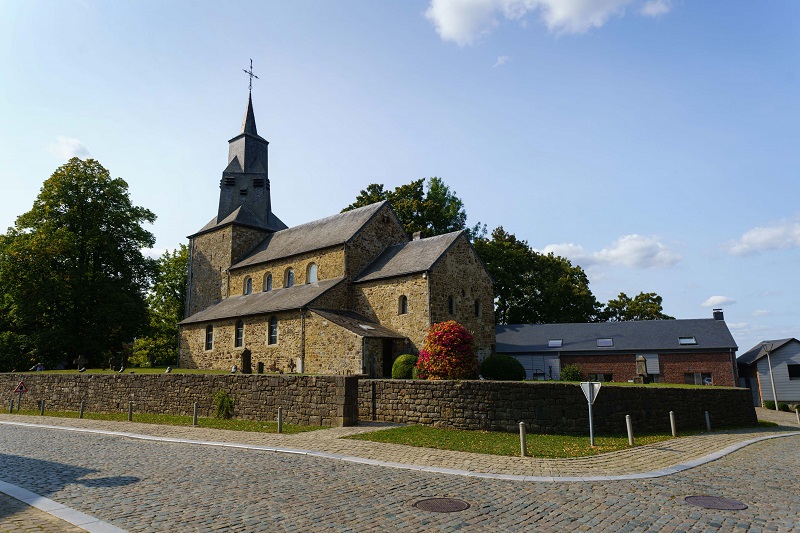
L'église romane Saint-Etienne et ses vitraux de Jean-Michel Folon

Discovery and recreation

Among the oldest Romanesque churches in Belgium, Saint-Etienne Church is the only one to have preserved its dedicatory stone. Adorned with stained glass created by Jean-Michel Folon, the last work of the artist, this remarkable Romanesque edifice (1050), classified as Major Heritage of Wallonia, holds many other treasures (works by the Master of Waha ...). This remarkable Romanesque edifice (1050), classified as Major Heritage of Wallonia, is surrounded by its ancient cemetery and preceded by a centuries-old lime tree under which a White Monk Priest reflects. As one of the oldest Romanesque churches in Belgium, it is the only one to have retained its dedicatory stone commemorating the consecration of the church on June 20, 1050, by Théoduin, Bishop of Liège from 1048 to 1075. This unique and rare piece is both a historical document and a work of art. The church also houses the ornamental stone bearing the coat of arms of Philip II, as well as the crests of Luxembourg and the city of Marche, 16th-century baptismal fonts, a 16th-century Gothic lectern, funeral slabs from the 15th to the 18th centuries, a 13th-century reliquary, a fragment of a 13th-century mural fresco, a fragment of Christ on the cross from the 16th century, as well as several works by the mysterious "Master of Waha," a 16th-century sculptor, one of the most remarkable being the calvary. This rich heritage is enhanced by the fabulous play of colors emanating from the stained glass created by Jean-Michel Folon, which recalls the martyrdom of Saint Etienne, the patron of the parish. At the back of the church, an audiovisual display presents the artist's testimony, along with some comments on the major pieces of the church's heritage. At the front, another display is dedicated to the works of the Master of Waha, several sculptures of which are also visible at the Famenne Museum. The surroundings of Saint-Étienne Church and the ancient cemetery (classified in 1941) were classified in 1972. The houses date back to the 19th century. The former presbytery, opposite the church tower, now houses the UFH (Francophone Union of the Disabled). At numbers 3-4, the former town hall. Number 6 is a residence from the second half of the 19th century, and number 7 is the current presbytery.
Address rue du Maquis 6900 Waha
Phones +3284345327

Welcome & accessibility

09:00-17:00.

Equipment & services

Parking

Share the article

Currently on Marche